🎛️ Producer situation
A producer sends a beat on Instagram DM to an artist. The artist records on it. The song gets 2M streams. No agreement. No proof. The producer has nothing — the artist claims he "made" the beat.

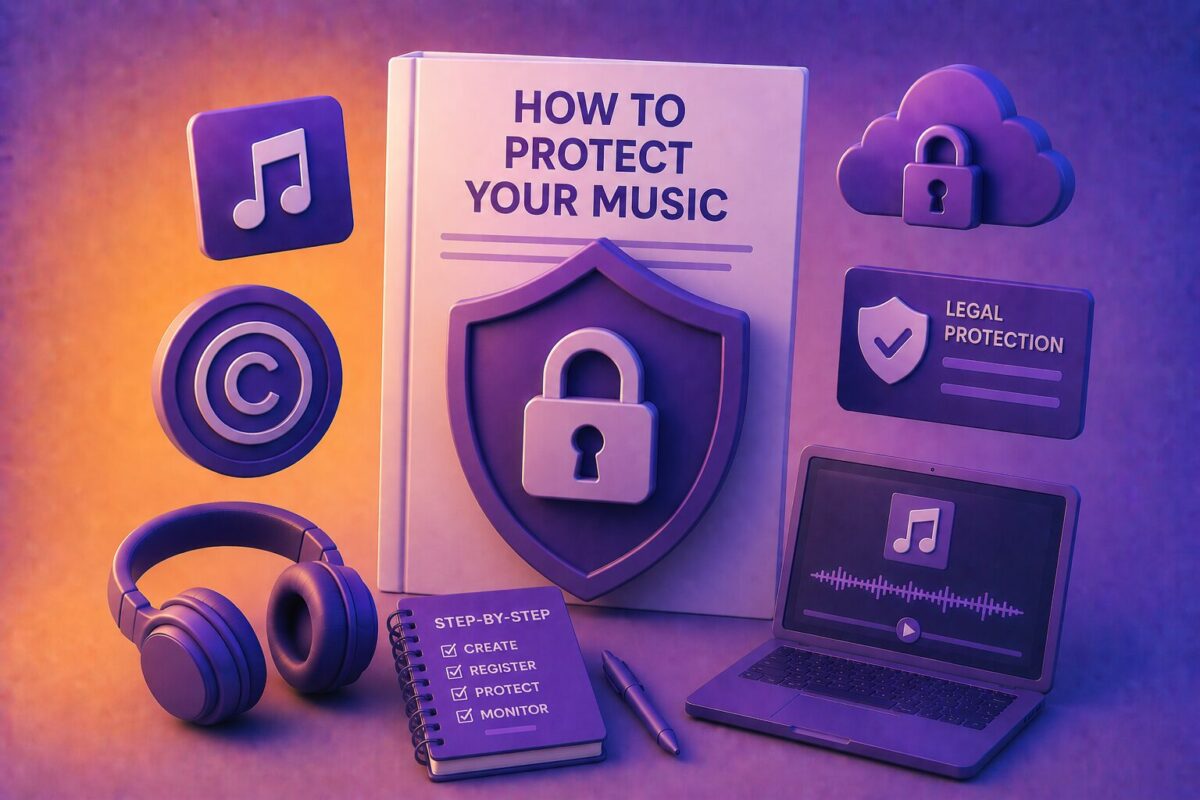
Beats, songs, lyrics, demos, stems — most artists lose their work before it comes out. This guide shows you exactly how to protect your music before sending it to anyone.
Tezos Blockchain · eIDAS Standard · 170+ countries · 2 minutes · No credit card
Copyright protects your music automatically — but without proof of creation date, it's nearly impossible to enforce. That's the gap TuneLockr fills.
Send a beat on WhatsApp or Drive — someone records on it, releases it, claims it was theirs. No proof = no case.
Share a topline before signing anything. It gets used without credit. Without a timestamped document, you can't prove you wrote it first.
Co-writing disputes are among the most common in music. Who wrote what? When? Without dated proof, nobody wins.
In the AI era, a file can be copied, remixed and reposted in seconds. A timestamped proof changes the power dynamic completely.
Bottom line: you have rights automatically — but rights without proof are nearly impossible to enforce. Protecting your music means creating that proof before your music leaves your hands.
These happen every day. No drama — just the reality of sharing music without protection.
A producer sends a beat on Instagram DM to an artist. The artist records on it. The song gets 2M streams. No agreement. No proof. The producer has nothing — the artist claims he "made" the beat.
A topliner shares lyrics before signing anything. The producer uses the hook with another artist. No timestamped document. The lawsuit costs more than the song ever made.
Two artists write together. One releases the track solo. No split sheet. No version history. The co-writer can't prove their contribution — percentage = 0.
The solution is simple: deposit your file on TuneLockr before sharing anything. 2 minutes. Free first deposit. Your timestamped certificate becomes your evidence.
Don't just protect the final master. Protect every strategic version — the ones you send, the ones that change, the ones that matter.
| What to protect | Format | When to deposit | Priority |
|---|---|---|---|
| Final song / master | MP3, WAV, FLAC | Before distribution on Spotify / Apple | Critical |
| Beat / instrumental | MP3, WAV | Before sending to any artist or client | Critical |
| Demo / work-in-progress | MP3, WAV | Before any external share | Critical |
| Lyrics / topline | PDF, TXT | Before co-writing session or pitch | Critical |
| DAW project (full session) | ZIP | Before production collaboration | Important |
| Stems / separated tracks | WAV, ZIP | Before remix or licensing | Important |
| Cover art / visuals | PNG, JPG | Before publication | Useful |
Pro tip: deposit the version you're about to send — not the final master from 3 weeks later. The proof must precede the share, not follow it.
Not all methods offer the same level of protection. Here's an honest comparison.
| Method | Speed | Cost | Legal strength | Best for |
|---|---|---|---|---|
| TuneLockr Recommended | 2 minutes | 1st free, from €4.90 | Strong — eIDAS + Tezos | Artists, producers, frequent sharing |
| U.S. Copyright Registration | Weeks | $35-65 per work | Very strong (US) | Published works — US market |
| SACEM / PRO registration | Weeks | Membership fees | Good — royalty collection | After commercial release |
| Soleau envelope (INPI) | 15 days | €15 | Good — France only | Occasional high-value works |
| Email to yourself | Instant | Free | Weak — not reliable in court | Nothing serious |
| Cloud storage (Drive, Dropbox) | Instant | Free / subscription | Weak — no independent proof | Storage only, not proof |
The winning strategy: TuneLockr before every share (proof of ownership) + PRO registration after release (royalty collection). They complement each other — they don't compete.
The fastest way to create a legally recognized proof of ownership — before you send anything.
MP3, WAV, PDF lyrics, ZIP project — any format works. You can protect a demo, a beat, a work-in-progress. The earlier you protect, the stronger your position.
Free registration at app.tunelockr.com — no credit card required for the first deposit. No membership in any PRO required.
TuneLockr calculates a unique cryptographic fingerprint of your file and records it on the Tezos blockchain — immutable proof that this exact file existed at this exact moment.
Timestamped certificate, eIDAS compliant, valid for life in 170+ countries. Stored in your artist space and accessible anytime.
Send your beat, demo or lyrics to whoever you want — your proof of ownership is established and irrefutable before anything leaves your hands.
Tezos blockchain · eIDAS standard · Valid for life in 170+ countries · 2 minutes · No credit card
Start protecting for free →Every time your music leaves your hands, it's exposed. Here's when you must protect it.
Before sending any beat, instrumental or track to an artist, client or manager — deposit it first. One deposit, 2 minutes, and your rights are documented.
Before a co-writing or co-production session — deposit your existing contribution. Your dated certificate clearly defines what you brought to the table before the session.
Before sending a demo to a label, manager or publisher — protect your track first. Labels receive thousands of demos. Your proof ensures your work stays yours.
Before uploading to YouTube — protect the version you're uploading. Once it's public, it can be copied, remixed or claimed. Your proof predates the publication.
Before distributing on Spotify, Apple Music or any streaming platform — deposit your master. This is your final version: protect it before it goes global.
Before posting an excerpt on Instagram, TikTok or Twitter — your music is immediately accessible and shareable. Protect first, post after.
Copyright protects your music automatically — but understanding what it covers (and what it doesn't) is essential to effectively protect your music.
| Element | Protected by copyright | Needs proof of ownership |
|---|---|---|
| Original melody | Yes — automatically | Yes — to prove priority |
| Lyrics / words | Yes — automatically | Yes — especially in co-writing |
| Audio recording (master) | Yes — automatically | Yes — before sharing |
| Beat / instrumental | Yes — if original | Yes — before sending |
| A musical genre | No — too general | N/A |
| A chord progression | No — too common | N/A |
| A musical concept / idea | No — ideas aren't protected | N/A |
Before any publication or sharing — timestamped certificate, blockchain Tezos, eIDAS. This is your evidence of creation date.
Use DistroKid, TuneCore or CD Baby with Content ID enabled on YouTube — automatic detection of any unauthorized use of your music.
Add © [Your Name] [Year] in your audio file ID3 tags and in YouTube descriptions. Small step, strong signal.
Official resources: WIPO — Copyright · U.S. Copyright Office · EU eIDAS Standard
Collaborations are the #1 source of music disputes. Here's how to protect yourself without killing the creative vibe.
Simple rule: before any collaboration — deposit what's yours on TuneLockr. After the session — deposit the final version. This chronology is your strongest protection if things go wrong.
To protect your music before sending it: upload your file to TuneLockr — timestamped certificate on Tezos blockchain in 2 minutes, valid in 170+ countries, first deposit free. Then send. The rule: protect first, share after. Your certificate proves you created the work before it was shared. Start free →
Copyright exists automatically — but without proof of creation date, it's very difficult to enforce. If someone claims your beat or lyrics are theirs, you need a timestamped document that proves you created it first. That's exactly what TuneLockr provides: an irrefutable proof of ownership, dated to the second.
To prove you made a song first, you need a timestamped proof of ownership linking your file to a specific creation date. TuneLockr creates this in 2 minutes: your file is cryptographically hashed and recorded on the Tezos blockchain — an immutable and independently verifiable record. This certificate is your strongest evidence in any dispute.
Yes. Once you send a beat without prior proof of ownership, it becomes very difficult to prove it was yours if a dispute arises. The other party only needs to claim they created it first — and without a timestamped certificate predating the share, you have no strong evidence. Always protect your beat on TuneLockr before sending it to anyone.
TuneLockr protects all your musical creations: beats and instrumentals (MP3, WAV, FLAC), full songs and masters, lyrics and toplines (PDF, TXT), demos and work-in-progress, DAW project files (ZIP), stems and separated tracks, visuals and cover art. One deposit can contain multiple files.
No. Emailing yourself a file is not considered strong proof in most legal situations. The timestamp can be questioned, the link between the email and the actual file can be disputed. TuneLockr uses Tezos blockchain to create an immutable, independently verifiable proof — far more reliable than a self-email.
Protect your music: before sending a beat or demo to anyone, before a collaboration session, before uploading to YouTube or Spotify, before pitching to a label or manager, before posting on social media. The rule: protect first, share after. A proof created after sharing is much weaker legally.
To protect music copyright online: 1) Create proof of ownership with TuneLockr before publication. 2) Distribute with Content ID (DistroKid, TuneCore, CD Baby) to detect unauthorized uses on YouTube. 3) Register with your PRO (ASCAP, BMI, PRS, SACEM) to collect royalties. 4) Add © metadata to your audio files.
With TuneLockr, protecting your music takes less than 2 minutes. Upload your file, receive your timestamped certificate instantly. No appointment, no paperwork, no waiting. First deposit is free — no credit card required.
Yes — and it's strongly recommended. Protect key versions: demo (V1), arrangement (V2), pre-master, master, and lyrics separately. In a dispute, the chronology of versions is often the deciding factor. Each deposit creates an independent, dated proof for that specific version.
Especially for independent artists. Without a label's legal team, you're more exposed — you share files frequently without formal agreements, collaborate without split sheets, and pitch demos without protection. TuneLockr gives independent artists the same level of documentation as major label releases, at a fraction of the cost.
16,489 artists already protect their music with TuneLockr. Tezos blockchain, lifetime certificate, valid in 170+ countries. First deposit free — no credit card.
2 minutes · No credit card · Lifetime proof · 170+ countries
Guides for every type of musical creation and every situation.
Complete guide in French.
Read →Workflow complet.
Read →Complete guide (FR).
Read →Guide for producers.
Read →3 legal methods.
Read →Content ID + TuneLockr.
Read →All plans and options.
See →Step-by-step process.
See →Beathoven complete guide.
Read →Free first deposit.
Start →Official sources: WIPO — Copyright · U.S. Copyright Office · ASCAP · BMI · PRS for Music · eIDAS Regulation
Adding {{itemName}} to cart
Added {{itemName}} to cart