Proof of Music Ownership in 2026 : How to Prove You Own a Song
🔐 TuneLockr — Proof of Music Ownership
Proof of Music Ownership
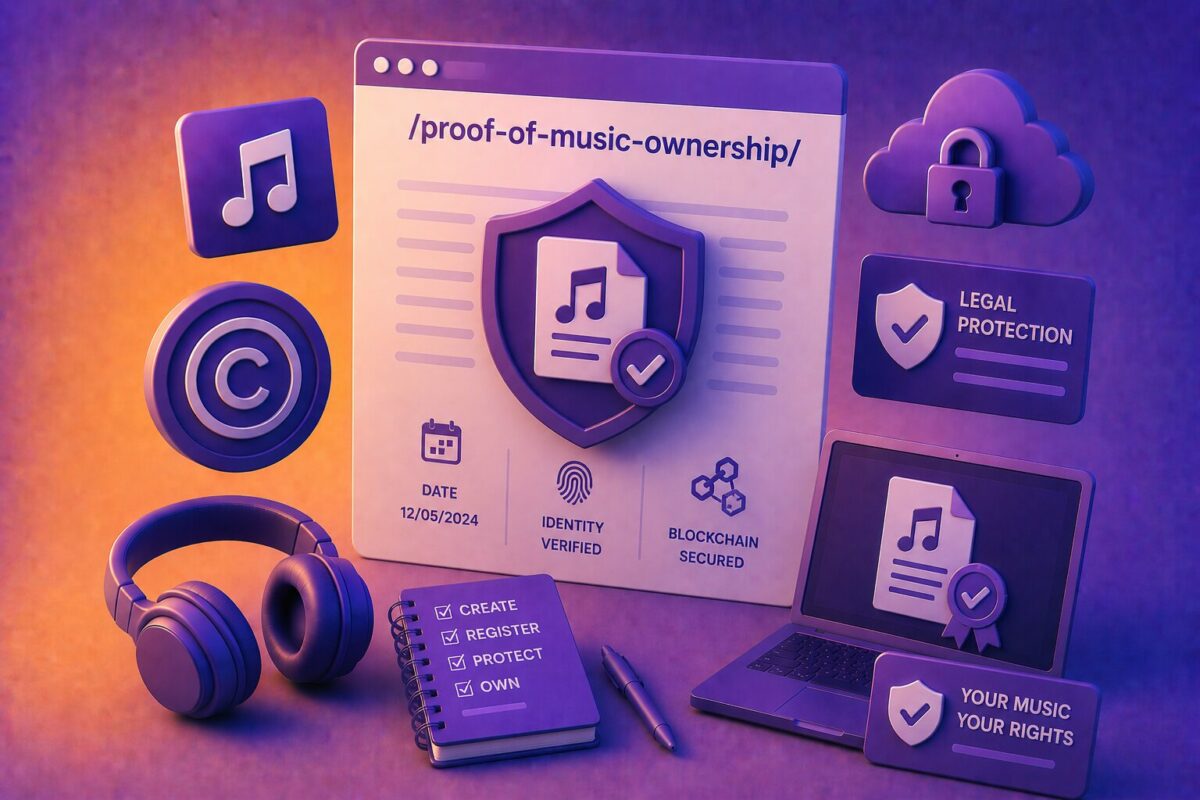
Copyright exists automatically — but proof of music ownership is what makes it enforceable. This guide explains what counts as valid proof, what doesn't, and how to create an irrefutable timestamped record in 2 minutes.
1st deposit free — no credit card — blockchain proof in 2 min
What counts as proof of music ownership — and what doesn't
Not all "proof" is equal. Courts and platforms have very different standards for what constitutes valid proof of music ownership. Here's a clear breakdown.
Cryptographic fingerprint of your file recorded on an immutable public blockchain, eIDAS compliant, independently verifiable, valid in 170+ countries. Timestamped to the second. The strongest standalone proof available to independent creators.
Strong
U.S. Copyright Office registration
Official legal registration in the United States. Very strong in U.S. courts — enables statutory damages and attorney's fees. But: slow (weeks to months), costs $35-65 per work, not practical for frequent iterations.
Strong
Notarized document
A notary certifies the existence of your file at a specific date. Very strong legal value — but expensive ($100-300+), requires appointment, impractical for regular use by active creators.
Medium
PRO registration (ASCAP, BMI, PRS, SACEM)
Documents that you claimed authorship at a given date. Useful supporting evidence — but not primarily designed as proof of creation date and doesn't predate the registration process.
Medium
Soleau envelope — INPI (France)
French official deposit. Recognized by French courts. 15€, 15 days processing. Good complement for high-value works but too slow for everyday creative workflow.
Weak
Email to yourself
A common myth. The timestamp can be questioned, the link between the email and the actual file can be disputed, and it provides no independent verification. Rarely accepted as strong proof alone.
Weak
Cloud storage timestamp (Drive, Dropbox)
File history exists — but it can be modified, manipulated, or questioned. Not designed as legal proof of music ownership. Useful as supplementary evidence, not as primary proof.
Weak
Social media post / YouTube upload date
Proves the date of publication — not the date of creation. A file can be created months before it's posted. Useful context but not standalone proof of music ownership.
Best practice: TuneLockr before every send (proof of prior creation) + Copyright Office / PRO registration after release (royalty collection + legal reinforcement). These stack — they don't compete.
Why proof of music ownership matters in 2026
Copyright protects your music automatically the moment you create it. But automatic copyright is not self-enforcing — you need to be able to prove you created the work, at a specific date, before the other party in a dispute.
🚨 The scenario that plays out every day
A producer sends a beat to an artist. The artist records on it, releases the track. When the producer asks for credit and payment, the artist claims the beat was "based on something I hummed first" — or simply ghosts the producer.
Without a timestamped proof of music ownership predating the send, the producer has no case. With a TuneLockr certificate showing the beat existed 3 weeks before the artist ever heard it — the producer has everything they need.
⚡
Speed of music sharing
Music gets shared instantly via DM, Drive, WeTransfer. The faster you share, the more you need proof that precedes the share.
🤖
AI and music in 2026
AI tools can generate music that sounds similar to yours. Proof of prior creation becomes the deciding factor in ownership disputes.
🌍
Global collaborations
You collaborate with artists across countries. Different legal systems — a blockchain timestamp is universally recognized via eIDAS.
How to create proof of music ownership with TuneLockr
1
Prepare your file
Any format: MP3, WAV, FLAC (audio) · PDF, TXT, DOCX (lyrics) · ZIP (full project, stems, DAW session). One deposit can contain multiple files.
2
Create your free TuneLockr account
No credit card for the first deposit. Sign up at app.tunelockr.com in 30 seconds. No PRO membership required.
3
Upload your file
TuneLockr calculates a unique SHA-256 cryptographic hash of your exact file and records it on the Tezos blockchain — immutable, timestamped to the second, publicly verifiable by anyone.
4
Receive your proof of ownership certificate
Instant PDF certificate — your proof of music ownership. Contains the timestamp, your file's cryptographic fingerprint, and a blockchain transaction reference. eIDAS compliant. Valid in 170+ countries, forever.
5
Share with confidence
Your proof predates any share, collaboration or release. If ownership is ever disputed, you have the strongest possible evidence: a blockchain-verified record that your music existed before anyone else had access to it.
🔐 Create your proof of music ownership now
1st deposit free · Tezos blockchain · eIDAS standard · Lifetime certificate · 170+ countries
Proves the beat was yours before the artist ever heard it
Co-writing session
Your contribution + final version
Before and after session
Defines each contributor's input with a clear chronology
Pitching to a label
Demo / full track
Before the pitch
Labels receive thousands of demos — your proof predates theirs
Ghost-writing (lyrics or music)
Lyrics PDF / audio file
Before delivery
Permanent record of authorship even after rights transfer
YouTube / Spotify release
Final master
Before upload
Proves creation date precedes publication
Sync / licensing pitch
Master + stems
Before pitching
Sync deals require clean chain of ownership — your certificate documents it
All methods to prove music ownership : full comparison
Method
Speed
Cost
Legal strength
International
Best for
TuneLockrRecommended
2 min
1st free, from €4.90
Strong — eIDAS + Tezos
170+ countries
All creators — before every share
U.S. Copyright Office
Weeks
$35-65 / work
Very strong (US)
Mainly US
Published works — US market
Notary
Days
$100-300+
Very strong
Varies
Very high-value works
PRO (ASCAP/BMI/PRS/SACEM)
Weeks
Membership fees
Good — royalties
International
After commercial release
Soleau / INPI
15 days
€15
Good — France
France only
High-value FR works
Email to yourself
Instant
Free
Weak
Not recognized
Not recommended alone
The winning stack: TuneLockr (before every send → proves prior creation) + U.S. Copyright Office or PRO registration (after release → royalties + legal reinforcement). These layers of proof of music ownership give you the strongest possible position in any dispute.
How to use your proof of music ownership in a dispute
1
Locate your TuneLockr certificate
Log into your TuneLockr account and find the certificate for the disputed work. Note the timestamp — this is the date you'll reference as your proof of prior creation.
2
Gather supporting evidence
DAW session file dates, email threads, message history, social media drafts, voice notes — anything that corroborates your creation timeline. Your TuneLockr certificate is the anchor, the rest is supporting context.
3
Report to the platform
YouTube, Spotify, TikTok, SoundCloud — use their copyright dispute form. Attach your TuneLockr certificate as proof of prior music ownership. Most platforms will act on a blockchain-verified certificate.
4
Send a cease and desist
Formal letter demanding the other party stop using your music and acknowledge your ownership. Reference your TuneLockr certificate date explicitly. This often resolves disputes without litigation.
5
Consult an IP attorney
If the dispute escalates, an intellectual property attorney can build your case around your TuneLockr certificate. The blockchain timestamp is your anchor — dated before the other party ever had access to your music.
FAQ — Proof of music ownership
To prove you own a song, you need a timestamped proof of music ownership linking your file to a specific creation date. TuneLockr creates this in 2 minutes: your file is cryptographically hashed and recorded on the Tezos blockchain — immutable and independently verifiable. This certificate is your strongest evidence in any dispute. Create your proof free →
Strong proof of music ownership includes: TuneLockr blockchain certificate, U.S. Copyright Office registration, notarized document, Soleau envelope (France). Weak proof includes: self-emails, cloud storage timestamps, social media posts. The strongest approach: TuneLockr before every share + PRO registration after release.
U.S. Copyright Office registration is strong proof of music ownership — but slow (weeks), costs $35-65 per work, and isn't practical for frequent iteration. TuneLockr is faster (2 minutes), cheaper (1st free), and global via eIDAS. Use both: TuneLockr before every share, Copyright Office for final published works.
To prove ownership of a beat: upload the file (WAV, MP3, ZIP) to TuneLockr before sending to any artist. Your certificate timestamps the beat to the exact second — proving it was yours before it left your hands. Keep intermediate versions as additional support. See: how to protect a beat.
No — emailing yourself a music file is not strong proof of music ownership. The timestamp can be challenged and the link to the actual file is easily disputed. TuneLockr uses Tezos blockchain for immutable, independently verifiable proof — far more reliable in a dispute.
In a collaboration dispute, your proof of music ownership must show what you contributed and when. Deposit your individual contribution on TuneLockr before the session (proves what you brought), and deposit the final version after (proves the co-created result). This chronology clearly defines each contributor's input. See: complete music protection guide.
PRO registration (ASCAP, BMI, PRS) registers your work for royalty collection — not primarily as proof of music ownership in a dispute. It documents that you claimed authorship at a given date, which supports your case. But TuneLockr creates a stronger, timestamped proof that predates your PRO registration — use both.