What is music plagiarism?
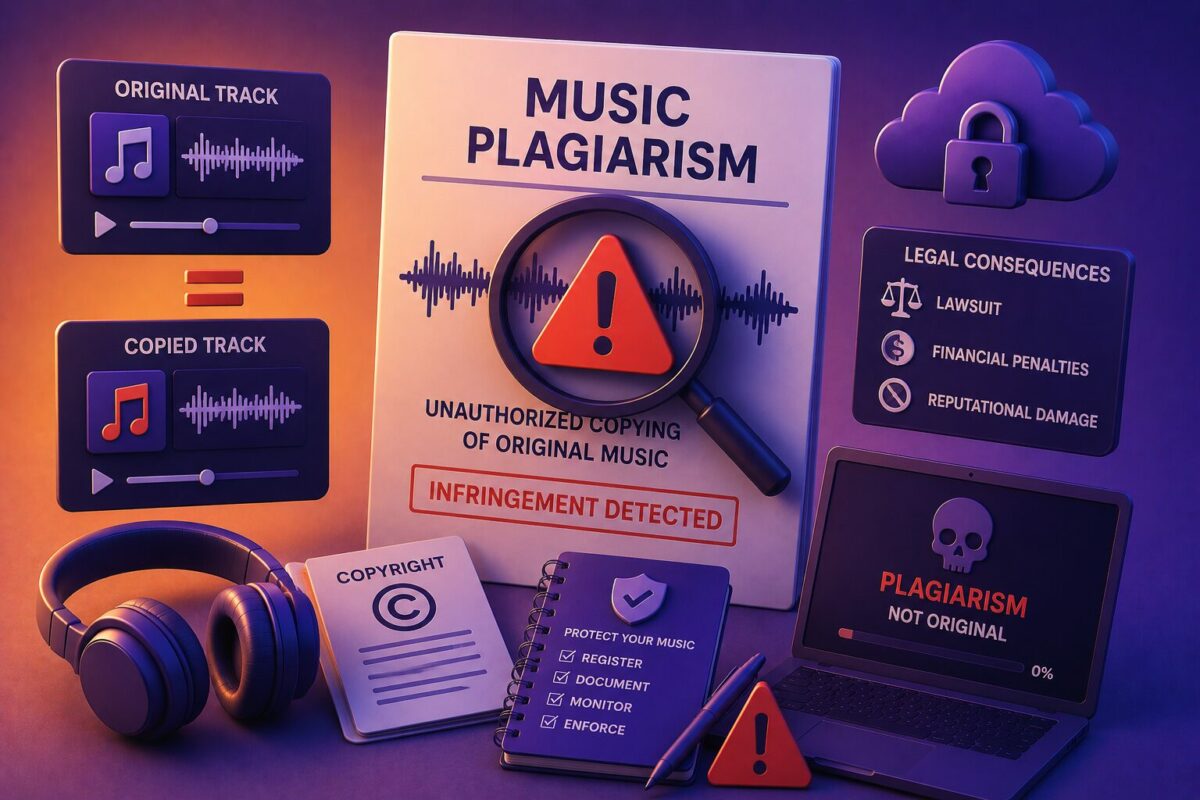
Music plagiarism occurs when someone uses a substantial and recognizable part of your original musical work without permission and without credit — passing it off as their own creation.
❌ What constitutes music plagiarism
- Copying a distinctive melody or hook
- Using your beat without authorization
- Reproducing your lyrics without credit
- Copying a highly distinctive chord progression
- Reproducing your distinctive musical structure
✅ What is NOT plagiarism
- Using the same genre or musical style
- Similar chord progressions if they're common
- Independent creation of something similar
- Licensed sampling with proper clearance
- Coincidental similarity without copying
Legal definition: music plagiarism is a form of copyright infringement — illegal under the U.S. Copyright Act and equivalent laws worldwide. In the US, damages range from $750 to $150,000 per work. In France, it's a criminal offense: up to 3 years in prison and €300,000 in fines.
Types of music plagiarism
| Type | What's copied | Common scenario | Difficulty to prove |
|---|---|---|---|
| Melody plagiarism | A distinctive melodic phrase or hook | A song's chorus mirrors yours note for note | Medium — needs musicologist |
| Lyric plagiarism | Lines, verses or full lyrics | Your lyrics appear in another song verbatim | Easier — text comparison |
| Beat theft | Your beat used without authorization | Artist releases a song using your beat — no agreement | Easier — audio fingerprint |
| Structural plagiarism | Song arrangement / production style | "Feel" and structure mirror yours precisely | Hard — subjective |
| Unauthorized sampling | Actual audio recording lifted | Your audio appears in another track without clearance | Easiest — identical audio |
How to detect music plagiarism
Detecting that your music has been plagiarized requires both tools and attentiveness. Here are the most effective methods.
Shazam / SoundHound
If you hear a suspicious song, use Shazam to identify it and compare directly with your work. Fast and accessible for obvious cases of beat theft or direct copying.
YouTube Content ID
Distribute via DistroKid, TuneCore or CD Baby with Content ID enabled — YouTube will automatically flag any video using your music without authorization.
Soundcharts / Chartmetric
Monitor streaming platforms for songs that sound similar to yours. Alert systems for mentions of your artist name or track titles across platforms.
BeatStars / Airbit alerts
If you sell beats, these platforms have monitoring systems that can detect unauthorized use of your productions on streaming services.
Listen actively
The most basic method — staying aware of new releases in your genre. Your community, fans, and peers often alert you to suspicious similarities before any tool does.
AI detection tools
Emerging AI tools can compare melodic DNA between tracks. Still evolving — but increasingly useful for detecting subtle melodic plagiarism that audio fingerprinting misses.
What to do if your music is plagiarized : step-by-step
Don't panic — act systematically. The stronger your prior proof of music ownership, the stronger your position.
Gather your proof of prior creation
Your TuneLockr certificate is the anchor — it proves your music existed before the plagiarized work was released. Also gather: original project files, DAW session dates, email threads, social media posts with your music, any dated exchanges related to the work.
Document the similarities precisely
Don't just say "it sounds like mine." Identify the exact elements copied: timestamp in both tracks, specific melodic phrases, lyric lines, structural elements. The more precise your comparison, the stronger your case.
Report to the streaming platform
YouTube: submit a DMCA copyright complaint. Spotify: use the Rights Holder Reporting form. TikTok: use the Intellectual Property Infringement form. Instagram: use the Copyright Report form. Attach your TuneLockr certificate as proof of prior ownership.
Contact the other party directly (optional)
Sometimes plagiarism is unintentional — or the other party is unaware of the issue. A direct message before escalating can resolve some situations quickly. Keep all exchanges in writing.
Send a formal cease and desist letter
A cease and desist demands the other party stop using your music and acknowledge your ownership. Include your TuneLockr certificate date, the specific elements plagiarized, and what you're requesting (removal, credit, compensation).
Consult an intellectual property attorney
If the other party doesn't comply, an IP attorney can file a copyright infringement lawsuit. In the US, registering with the Copyright Office before or within 3 months of publication enables statutory damages and attorney's fees.
Key insight: the earlier your TuneLockr certificate predates the plagiarized work, the stronger your case. A proof dated 3 months before the infringing release is far more powerful than one created after you discovered the plagiarism.
How to file a DMCA takedown for music plagiarism
The Digital Millennium Copyright Act (DMCA) gives you the right to request removal of infringing content from online platforms. Here's how to file for the major platforms.
| Platform | Process | Response time | What you need |
|---|---|---|---|
| YouTube | Copyright complaint form | 10-14 business days | URL of infringing video + proof of ownership |
| Spotify | Rights Holder Reporting form | Variable | ISRC / distributor info + ownership proof |
| TikTok | IP Infringement Report | 3-5 business days | Link to content + proof of ownership |
| Instagram / Meta | Copyright Report form | Variable | Description of infringement + identity |
| SoundCloud | DMCA notice via email | Variable | Written DMCA notice with all required elements |
Your TuneLockr certificate is the document to attach to every DMCA notice and platform report. It provides the timestamped, blockchain-verified proof that your music predates the infringing content — which is exactly what platforms need to act.
How to prevent music plagiarism before it happens
The best time to protect yourself against music plagiarism is before it happens — not after. Here's the prevention checklist every creator should follow.
🔐 Before sharing any music
- Deposit on TuneLockr before every send
- Protect the version you're about to share — not the final master
- Keep all intermediate versions (V1, V2, demo)
- Use watermarked previews for feedback loops
📋 Before any collaboration
- Deposit your contribution before the session
- Sign a collaboration agreement / split sheet
- Keep all exchanges about the creation in writing
- Deposit the final version with all contributors noted
🎵 After releasing music
- Register with your PRO (ASCAP, BMI, PRS, SACEM)
- Enable Content ID via your distributor
- Add © metadata to all your audio files
- Monitor platforms for unauthorized use
⚖️ Legal layer
- Register with U.S. Copyright Office for published works
- Use licensing agreements for beats and sync
- Never send exclusives without a signed contract
- Know your PRO's dispute resolution process
🛡️ Protect your music before plagiarism can happen
TuneLockr — Tezos blockchain · eIDAS standard · Lifetime proof · 170+ countries · 1st deposit free
Create my proof of ownership →Music plagiarism vs sampling vs cover songs : what's the difference?
| Music plagiarism | Unauthorized sampling | Licensed sampling | Cover song | |
|---|---|---|---|---|
| Definition | Copying without acknowledgment | Using a recording without license | Using a recording with proper clearance | Recording your own version of existing song |
| Legal status | Illegal | Illegal | Legal | Legal with mechanical license |
| Intent | Pass off as original | Use without permission | Acknowledge and license | Tribute / interpretation |
| Remedy | DMCA + lawsuit | DMCA + lawsuit | No action needed | No action needed |
FAQ — Music plagiarism
Music plagiarism occurs when someone uses a substantial and recognizable part of your original work without permission — melodies, lyrics, beats, or arrangements — and presents it as their own creation. It's a form of copyright infringement, illegal in most countries. Penalties range from $750 to $150,000 per work in the US, and up to 3 years in prison in France.
Signs your music may have been plagiarized: a song sounds remarkably similar to yours in melody, lyrics or structure; your beat appears in a released track without authorization; your lyrics appear in someone else's song. Detection tools: Shazam (identify songs), YouTube Content ID (detect reuse), Soundcharts (monitor platforms), active listening in your genre.
If your music was plagiarized: 1) Gather your TuneLockr certificate + original files. 2) Document the similarities precisely. 3) Report to the platform via DMCA or copyright form. 4) Send a cease and desist. 5) Consult an IP attorney if needed. Your TuneLockr certificate — dated before the infringing work — is your central evidence of prior creation.
Yes — music plagiarism is a form of copyright infringement, illegal in most countries. In the US: $750 to $150,000 in damages per infringed work. In France: up to 3 years in prison and €300,000 in fines. The challenge is proving you created the work first — which requires timestamped proof of music ownership like a TuneLockr certificate.
To prevent music plagiarism: 1) Deposit on TuneLockr before every share — 2 minutes, 1st deposit free, Tezos blockchain. 2) Never send a beat, demo or lyrics without a prior certificate. 3) Sign agreements before collaborations. 4) Enable Content ID via your distributor. 5) Register with your PRO for published works. The rule: protect before you share — not after.
To file a DMCA takedown on YouTube: go to the YouTube copyright complaint form, identify the infringing video, provide your contact info and original work details, submit a sworn statement of good faith. Attach your TuneLockr certificate as proof of prior ownership. YouTube must respond within 10-14 business days. Similar processes exist on Spotify, TikTok and Instagram.
Licensed sampling = intentional use of an existing recording with proper clearance (legal). Unauthorized sampling = using a recording without license (illegal). Music plagiarism = copying musical elements and presenting them as original without acknowledgment (illegal). Cover songs = recording your own version of an existing song with a mechanical license (legal). Both plagiarism and unauthorized sampling require the original creator to have proof of music ownership.
Related resources
Proof of music ownership
How to prove you own a song.
Read →How to protect your music
Complete guide 2026.
Read →How to protect a beat
Guide for producers.
Read →How to protect song lyrics
Guide for songwriters.
Read →Protéger sa musique
Guide complet FR.
Lire →TuneLockr Pricing
All plans and options.
See →Protect my music now
1st deposit free, no CC.
Start →Protéger sa musique
Guide Beathoven 2026.
Lire →Official sources : U.S. Copyright Office · WIPO — Copyright · YouTube DMCA form · eIDAS Regulation