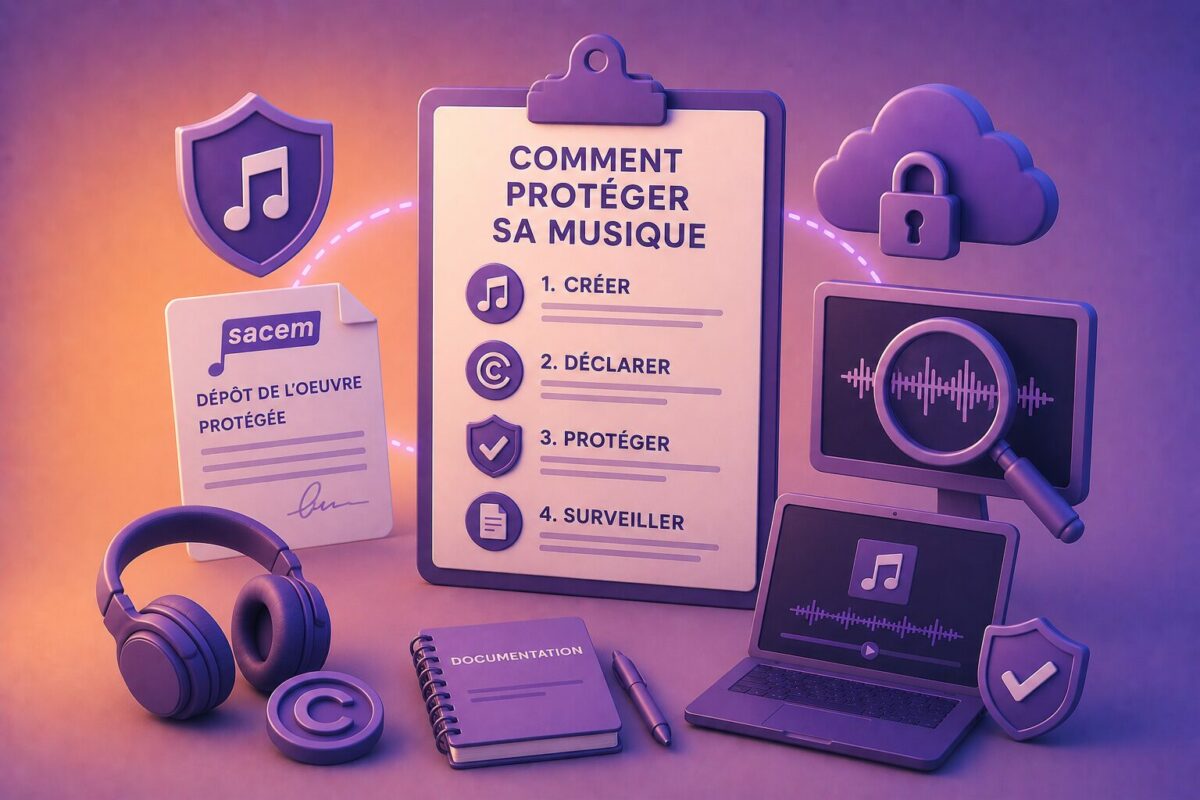
How protect his music
and their musical creations in 2026
Beats, lyrics, demos, versions — how to protect your music before release, before sending a demo, before collaborating. Complete guide with solution comparison, proof of priority and practical case studies.
✅ Register before release, before sharing and before any collaboration.
This article is based on the French Intellectual Property Code and on the experience of filing several thousand works via TuneLockr. Official sources cited at the bottom of the page. Find out more about the team →
How to protect your music: what it really means
When an artist seeks how to protect your music, he wants to answer several questions at once — how protect a song, a beat, lyrics, a demo, and how to prove he was indeed the first to create them.
In practice, protect his music means three distinct things:
Obtain dated proof showing that on a specific date, you already held the work in that version.
Clearly link the music, beat or lyrics to their author or co-authors, in an irrefutable way.
Keep the important stages: demo, V1, V2, topline, instrumental, master — to trace the timeline.
Why protect your musical creations is essential in 2026
Protect my music isn't just for signed artists. It's often even more important when you're independent — you more easily share files, demos, and work versions with collaborators, without an established legal framework.
A melody, topline, beat or progression can be reused or claimed by a third party without dated evidence.
Without dated proof, it's impossible to establish who created what, on which date and in which version if a dispute arises between co-authors.
Music that circulates unprotected becomes difficult to defend if a dispute arises later.
How to legally protect your music
Legally, the music copyright comes into effect at the moment of creation — with no formalities. But in reality, this rule is only useful if you can prove you originated the creation on a specific date.
Understanding how to legally protect your music means thinking in two stages:
- Content-wise — the creation exists and is protected by copyright from the moment it is made
- On evidence — you must be able to demonstrate the prior existence and authorship of the work in case of a dispute
What many people believe: "I have the file on my computer", "I sent it to myself by email", "it's in my cloud". These are fragile, debatable, and much less convincing than genuine proof of prior existence certified by a third party.
Proof of prior existence: the decisive factor for protect his music
The proof of prior existence is often the most important asset in any music protection strategy. It shows that, on a specific date, you already held a work, a beat, lyrics, or an identifiable version.
What a proof of prior existence allows you to do
- Date your creation before it circulates — irrefutably
- Keep a record of the important versions of a track
- Centralise your deposits in one place for quick access
- Reduce confusion when several people are working on a track
- Present proof in case of a dispute, plagiarism, or authorship challenge
How TuneLockr creates your proof of prior existence
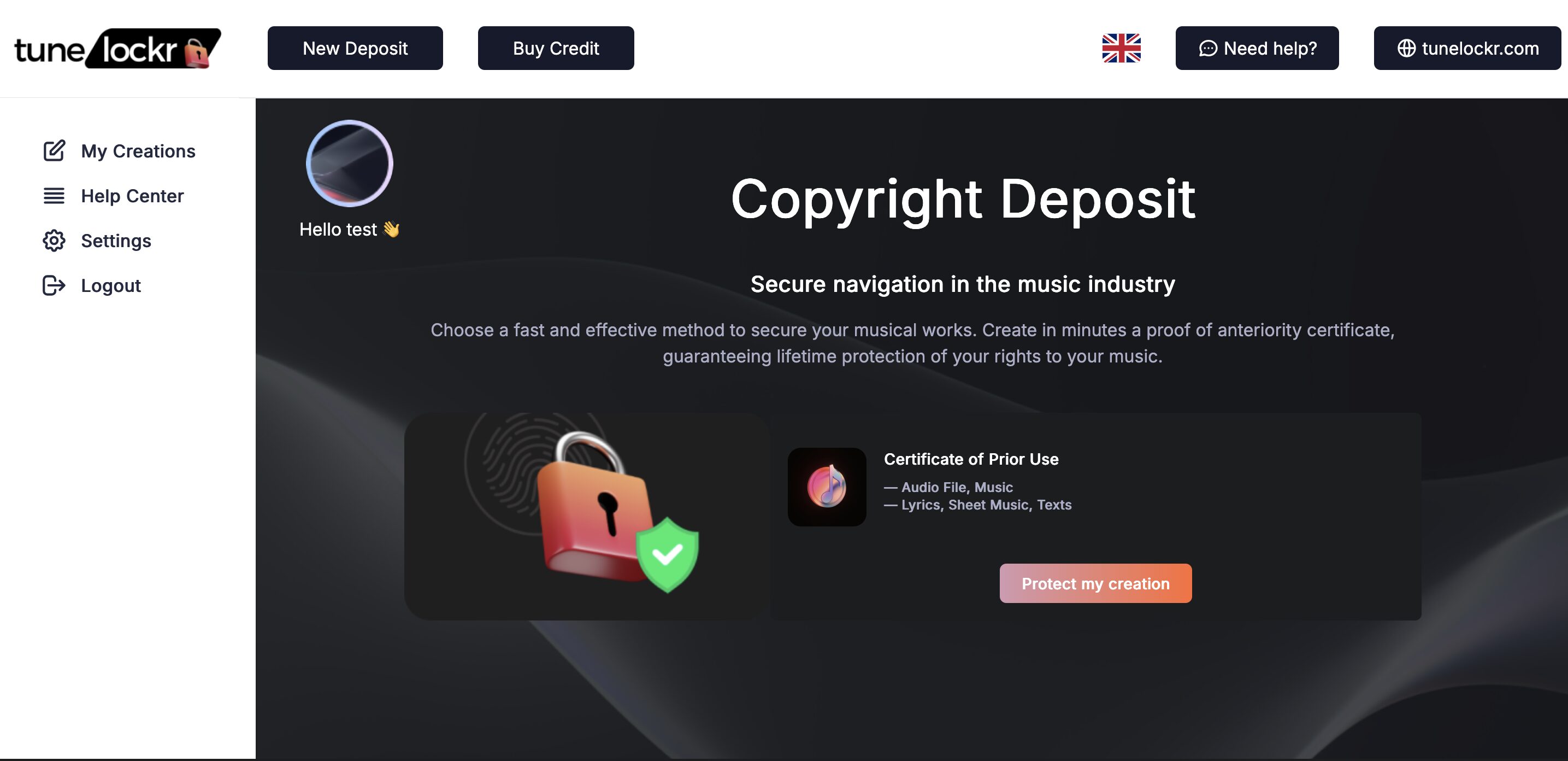
Upload your file
MP3, WAV, PDF lyrics, project ZIP — all formats are accepted. Deposit the file on TuneLockr in 2 minutes.
Cryptographic fingerprint
TuneLockr generates a unique digital fingerprint of your file and records it on the Tezos blockchain — immovable and tamper-proof proof.
Timestamped PDF certificate
You immediately receive a PDF certificate with the exact date and your file’s fingerprint — compliant with eIDAS regulations and valid in over 170 countries.
What to register for protect his music
When you search how to protect your musical creations smartly, the most effective approach is to register the strategic versions — not just the final master.
Final track, demo, radio edit, instrumental, bounce, alternative version.
Beat only, instrumental, original loop, production sent to an artist or a client.
Lyrics, vocal melody, structure, chorus draft, developed idea.
DAW session, stems, export of your work, key arrangement elements compressed in a ZIP.
Optimal recommendation: Submit the first usable version + the version shared with third parties + the final version. This timeline offers much better protection than a single late submission.
Comparison of solutions for protect his music in 2026
There is no single ‘right’ method: the best choice depends on your budget, urgency, and intended use (simple proof vs. rights management). Here is an honest comparison, including the limitations of each solution — TuneLockr included.
| Solution | Timeframe | Cost | Advantages | Limitations |
|---|---|---|---|---|
| TuneLockr | ~2 minutes | First upload free, then from €4.90 | Fast, all formats (MP3/WAV/PDF/ZIP), blockchain timestamping, version control | Recent private service — not yet tested by French courts in the same way as Soleau or a bailiff |
| Soleau Envelope (INPI) | A few days to 2 weeks | Around €15 | Issued by a public authority, established case law, good trust/price ratio | 5 years renewable once, only one item per envelope, less convenient for multiplying versions |
| SNAC (National Union of Authors-Composer) | Immediate to a few days | Varies by submission, not free | Online submission possible, recognised within the music industry, no compulsory membership | Does not manage copyright, paper recommended for scores |
| Registered letter to oneself | Immediate | ~€5-7 (postage fees) | Free or almost free, straightforward to do | Limited and contested evidentiary value: postmarks can be forged, envelopes may be reopened; best used as a backup, not as a sole solution |
| BNF legal deposit | A few weeks | Free | Public cultural institution, no time limit | Makes the work accessible to the public, designed more for archiving than for quick litigation proof |
| Notary / bailiff | By appointment | 100-300€ | Maximum evidential value, findings directly admissible in court | High cost for repeated use, poorly suited to frequent submissions (demos, multiple versions) |
| SACEM | Several weeks for membership | Joining fee ~€154 + rights management | Only solution to pay royalties for exploitation (radio, streaming, concerts) | Membership conditions (already exploited works), does not serve to prove prior creation before publication |
In short: for quick proof before sharing a demo, an online tool (TuneLockr, Soleau, SNAC) is more than sufficient. For an ongoing dispute or significant financial stakes, a bailiff's report remains the strongest form of evidence. SACEM intervenes at a different stage: after commercial exploitation, not before.
How the other solutions work, in detail
To make an informed choice, here’s how each of the alternatives mentioned in the comparison actually works.
The Soleau envelope (INPI)
You put together a file (recordings, sheet music, or a description of the work) in duplicate, which you submit online on the INPI website or by post. The Institute keeps one copy and returns the other to you, marked with an official date. Protection lasts for 5 years and can be renewed once. This is currently the most frequently cited official reference in France for dating a creation at a low cost.
SNAC deposit
The National Union of Authors and Composers offers a deposit service for works, online or by post, kept for 5 years. No prior membership is required. However, SNAC recommends paper format for sheet music, and this service does not allow for nor replace copyright collection.
The registered letter to yourself
You send your own work to yourself (CD, USB stick, or printed copy) by registered post with recorded delivery, and never open it — the delivery slip remains stuck to the flap as proof the envelope has stayed sealed. It’s free or almost free, but its value in court is regularly debated: technically, there’s nothing to stop someone getting an empty envelope stamped, then opening and refilling it later. Best used alongside another form of evidence, not on its own.
Legal deposit at the BNF
You can submit a phonogramme free of charge (audio file, CD, sheet music) at the National Library of France. This is a deposit with heritage and cultural objectives: your work becomes available to the public once deposited, which may not always be desirable if you haven't released your track yet.
Notary or bailiff
A public official makes a dated record of your creation, offering the highest level of evidential value as it is an official act. The cost (typically €100 to €300) and the waiting time for an appointment make this option less suitable if you need to protect several work-in-progress versions or dozens of beats per month — but it remains relevant for matters involving significant financial stakes or ongoing disputes.
An online timestamping service (TuneLockr and similar)
You upload your file, a digital fingerprint (hash) is generated and registered on a blockchain, and a timestamped certificate is delivered to you within minutes. Advantages: speed and low cost for frequent deposits. A fair limitation: these services are newer than the Soleau envelope or notarial act and have yet to build up the same case law in French courts — they provide strong technical evidence, but are best combined with an official deposit (Soleau or SACEM) for works with significant commercial value.
SACEM vs TuneLockr: what’s the difference for protect his music ?
This is the most common misunderstanding. SACEM and TuneLockr are not the same thing — they complement each other rather than compete.
- Timestamped evidence of priority — who, when, what
- Protection before release — even at the demo stage
- Valid in 170+ countries, eIDAS standard
- Beats, lyrics, demos, stems, ZIP files
- First deposit free, no card required
- Collects royalties for radio broadcasts
- Streaming royalties (Spotify, Deezer)
- Live concert and event rights
- Synchronisation (TV, advertising, film)
- Takes effect after the official release
| Criterion | TuneLockr | SACEM |
|---|---|---|
| Fast proof of prior creation | Yes — 2 minutes | No |
| Protection before mailing | Yes — from the demo | No |
| Copyright management | No | Yes |
| Membership required | No | Yes + fees |
| Beats, demos, lyrics | Yes — all formats | Limited |
| Used when | Before release | After commercial release |
Optimal strategy: TuneLockr first (proof of authorship before sharing) + SACEM afterwards (collecting royalties when your work is used). Both together = complete musical protection. See the SACEM vs TuneLockr guide →
When protect his music — key stages
The answer to how to protect your music is also about timing: before your work starts circulating.
- Before Spotify and Apple Music — before distributing your track on the platforms
- Before YouTube — before releasing a music video, lyric video or snippet
- Before sending a demo — label, media, playlist, curator, manager
- Before collaborating — topliner, guest artist, beatmaker, arranger
- Before selling a beat — especially if several versions are in circulation
- Before social networks — any snippet for TikTok, Instagram or YouTube Shorts
- Before a major release — single, EP, album or sync placement
Concrete cases: Spotify, YouTube, demos, beats, collaborations
How to protect your music before Spotify
Before putting your track on Spotify, register the version you intend to distribute on TuneLockr. If your piece has had several versions, also register the demo or key working version to generate a clear timeline.
How to protect your music before YouTube
Publishing on YouTube brings visibility — and exposes your music. The best practice: create your proof of priority before publishing, not after. A TuneLockr certificate before uploading is enough to protect your music before it goes on YouTube.
How to protect a beat
Beatmakers send their productions to several artists, clients or publishers. A beat should be protected before every send. TuneLockr allows you to register the instrumental in 2 minutes with a timestamped certificate. → Guide: how to protect a beat
How to protect a song's lyrics
Lyrics, a text, a topline or a draft can be uploaded as a PDF on TuneLockr. This is particularly useful before a shared writing session, pitching to an artist, or co-writing. → Guide: protecting the lyrics of a song
How to protect your musical works in collaboration
Collaborations often create grey areas — received instrumental, topline added, chorus rewritten. Register the key stages and keep the versions that show how the work has evolved to protect your contribution.
Music plagiarism: why you should protect your music before sharing it
Music plagiarism can affect a melody, a beat, a topline, lyrics or an arrangement. The more widely a creation is shared without clear evidence, the harder it becomes to prove its origin.
- Keep the source files — sessions, stems, exports, voice notes
- Register before sharing — before label, artist, manager, curator or social network
- Keep communications — emails, messages, time-stamped transfer links
- Compare closely — melody, structure, lyrics, hook, chorus
What to do if your music is plagiarised despite protection
Gather your proof
TuneLockr certificate, original files, date of first publication, correspondence history.
Contact the platform
YouTube, Spotify, TikTok — each platform has a copyright infringement report form. Attach your certificate as proof of prior creation.
Send a formal notice
Send a registered letter with acknowledgment of receipt to the plagiarist with your proof of authorship and withdrawal request.
Consult a solicitor
If no amicable resolution is found, a solicitor specialising in intellectual property can take the case to court. Your TuneLockr certificate is the key piece of evidence.
5 common mistakes when searching how to protect your music
Many artists only look into how to protect their music after a dispute. Protection is far more effective as a preventative measure.
Sending yourself a file is not legal proof. Metadata can be changed. No court will accept it on its own.
In many disputes, it’s the intermediate stages that demonstrate the creation timeline. Upload your important versions too.
Cloud, email, hard drive — such scattering complicates your case. Centralise your uploads in TuneLockr for the greatest clarity.
This is the most sensitive situation. Upload before and during each collaboration to safeguard your specific contribution.
SACEM manages exploitation rights — it doesn’t provide proof of prior creation. TuneLockr does what it does not.
What users have to say
"I uploaded my demo to TuneLockr before sending it to several labels. The upload was very quick and the certificate gave me peace of mind. Since then, I upload every important new version of my tracks."
"I work with several beatmakers and producers. Being able to date each version of our projects brings us real peace of mind during collaborations."
"Before releasing my single, I wanted to keep proof of my creation. The interface is simple, uploading takes just a few minutes and I received my certificate immediately."
FAQ — How to protect your music
For protect his music effectively: 1) Upload to TuneLockr before any sharing — time-stamped certificate in 2 minutes, valid in 170+ countries. 2) Upload before Spotify or YouTube. 3) Upload before sending to a label or collaborator. 4) Register with SACEM for commercial rights. Rule: upload before publishing, not after. First upload free →
Protect your musical creations : upload each strategic version to TuneLockr — finished track, lyrics, beats, demos, stems. A single upload can contain several files. Instant PDF certificate, eIDAS standard + Tezos blockchain.
Yes — copyright is automatically established at the point of creation. However, in the event of a dispute, you must be able to prove that you were the author before the other party. It is the proof of priority from TuneLockr — an irrefutable time-stamped certificate — that makes this right enforceable.
TuneLockr creates a time-stamped proof of authorship before distribution. SACEM SACEM collects royalties when your work is commercially exploited (radio, streaming, concerts). The two are complementary — use TuneLockr first, then SACEM. See: SACEM vs TuneLockr guide.
Yes — TuneLockr protects all formats: beats (MP3, WAV), lyrics (PDF, TXT), demos, stems, DAW projects (ZIP). See: how to protect a beat · how to protect the lyrics of a song.
Protect your music before: publishing on Spotify or YouTube, sending to a label or manager, collaborating, selling a beat, or sharing it on social media. The rule: register your music before it circulates, not after.
In cases of plagiarism: 1) Gather your evidence — TuneLockr certificate, original files, publication date. 2) Report to the platform (YouTube, Spotify). 3) Send a formal notice. 4) Consult an intellectual property lawyer. Your TuneLockr certificate is the key document. See: music plagiarism guide.
Resources for protecting your music
TuneLockr guides
Official sources
Key points: no tool can replace legal advice in a genuine dispute. TuneLockr is a quick and easy way to date your creations on a daily basis.
Protect my music for free →Conclusion
Learn how to protect your music and how to protect your musical creations is a foundation for every modern artist’s work. The most consistent approach: register early, register before publishing, register before sharing, keep important versions.
TuneLockr is the most suitable tool for this habit — fast, simple, legally recognised in 170+ countries, accessible to all independent artists.