How to Protect Your Music in 2026 (Before Sending It)
Most artists don’t lose their music after release. They lose it before it even comes out.
A beat gets sent. A demo gets shared. A topline gets reused. No credit. No proof. No control.
If you're wondering how to protect your music, this guide will show you exactly what to do.
Start free (no credit card)
What does it mean to protect your music?
Protecting your music means being able to:
- prove you created it first
- show a clear timestamp
- secure your versions
- avoid disputes
The mistake most artists make
Most artists send beats through WhatsApp, Drive, or email. They assume that’s enough.
It’s not.
Once your music is shared, you lose control without proof.
When should you protect your music?
- before sending a beat
- before collaboration
- before uploading to YouTube
- before Spotify release
Rule: Protect first. Share after.
How to prove ownership of your music
To prove ownership, you need:
- a timestamp
- a verifiable record
- a clear link to your file
Emailing yourself is not enough. Cloud storage is not reliable proof.
The fastest way to protect your music
With TuneLockr, you can:
- upload your file
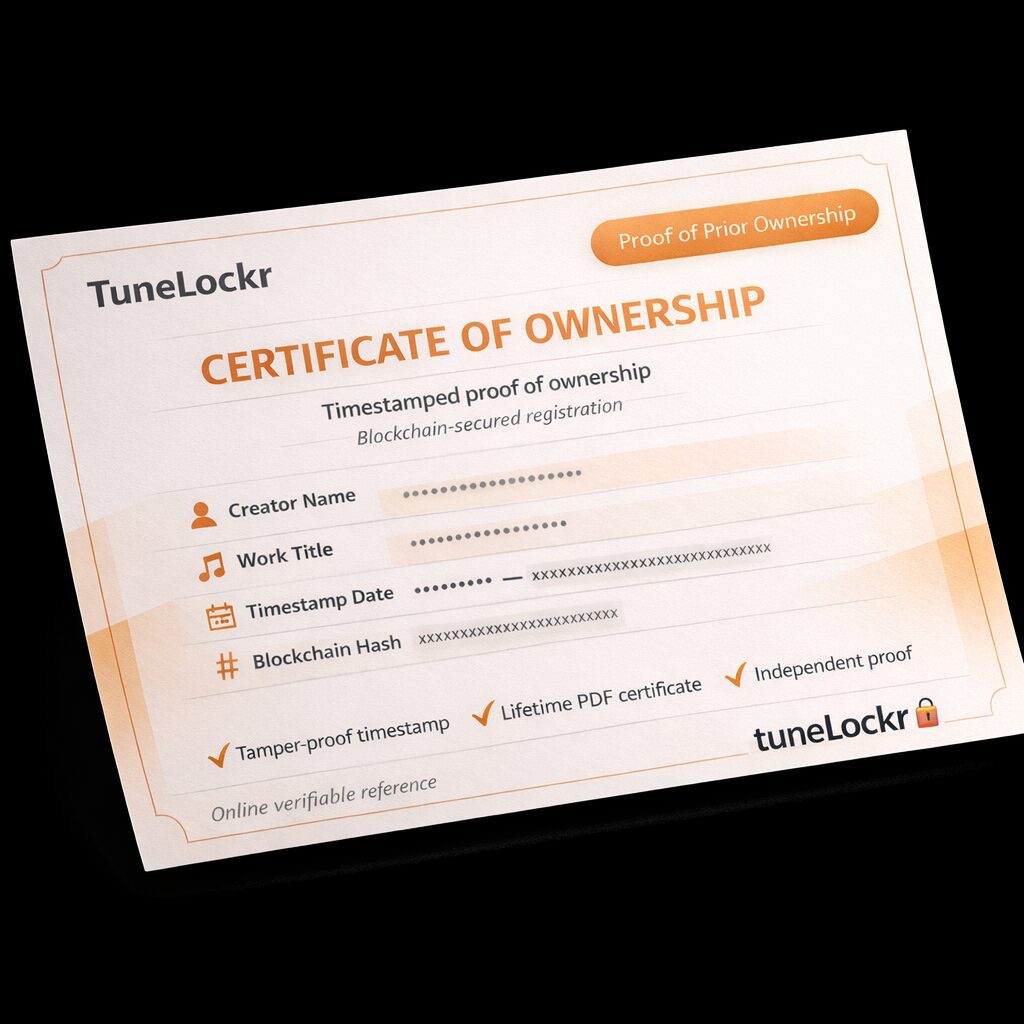
- generate a timestamped certificate
- secure your creation instantly
👉 Takes 2 minutes.
👉 Includes 1 free deposit (no credit card required).
What can you protect?
- beats
- songs
- lyrics
- demos
- stems
- instrumentals
Is copyright enough?
Technically yes. But in real situations: you need proof.
Learn more about copyright from: WIPO or U.S. Copyright Office.
Internal resources
FAQ
How can I protect my music for free?
You can start with a free deposit using TuneLockr.
When should I protect my music?
Before sending, sharing, or publishing it.
Can I protect a beat?
Yes, you should protect it before sending it to anyone.
Conclusion
Protecting your music is not optional anymore.
Before you send it. Before you share it. Protect it.
Real situations where artists lose their rights
A producer sends a beat to an artist on Instagram. The artist records on it. The song gets released. No agreement. No proof. 👉 The producer has nothing.
This happens every day.
Step-by-step: how to protect your music properly
- Create your file (beat, song, lyrics)
- Upload it to a protection platform
- Generate a timestamped certificate
- Store your versions
- Then share your music
Best Ways to Protect Your Music (Full Comparison)
If you're serious about protecting your music, you need to understand the strengths and limitations of each available method. Not all solutions offer the same level of protection, speed, or practicality for modern artists.
| Method | Type of Proof | Speed | Ease of Use | Best For | Limitations |
|---|---|---|---|---|---|
| TuneLockr | Timestamped certificate | Instant | Very easy | Artists, producers, frequent creators | Requires proactive use before sharing |
| Email to yourself | Weak timestamp | Instant | Easy | Basic personal tracking | Not reliable in disputes |
| Cloud storage (Drive, Dropbox) | File history | Instant | Easy | Storage | No strong legal proof |
| Copyright registration | Legal registration | Slow | Moderate | Published works | Not designed for fast iteration |
| Notary / legal deposit | Formal record | Slow | Complex | High-value works | Expensive and impractical |
👉 For modern creators who frequently share demos, beats, and collaborations, speed and repeatability matter. That’s why instant proof solutions are becoming the standard workflow.
What Artists Are Searching For (Music Protection Keywords)
Artists, producers, and songwriters search for many different ways to protect their music online. This guide covers all the key topics related to music protection and ownership.
- how to copyright a song
- how to prove ownership of music
- music copyright protection
- how to register a song
- protect beats before sending
- how to send beats safely
- protect music before sharing
- music demo protection
- music plagiarism protection
- can someone steal my beat
- protect against music theft
- how to avoid stolen music
- protect music online
- timestamp music file
- secure song files
- proof of creation music
👉 This page is designed to answer all these questions in one place — making it a complete resource for music protection.
Expert Recommendation
In today’s music industry, protecting your work is not optional — it’s part of a professional workflow.
Professional artists, producers, and composers don’t wait until a problem happens. They secure their work before it’s shared, sent, or released.
Whether you're sending a beat to an artist, collaborating on a track, or pitching a demo, having a clear and timestamped proof of ownership is what separates amateurs from professionals.
This approach is widely recommended across the industry, including guidance from institutions like WIPO and U.S. Copyright Office, which emphasize the importance of documentation and proof in protecting creative works.
👉 The most effective strategy is simple: make protection a habit — not a reaction.
Frequently Asked Questions About Protecting Your Music
Can someone steal my beat if I send it?
Yes. Once you send a beat without protection, it can be reused, modified, or claimed by someone else. Without proof, it becomes difficult to defend your rights.
How do I prove I made a song first?
You need a timestamped proof that shows the existence of your file at a specific date. This can be done using a structured music protection platform.
Is emailing myself a song enough proof?
No. While it creates a trace, it is not considered strong or reliable proof in most situations.
Do I need to copyright my music?
Copyright exists automatically, but proving ownership requires clear documentation and timestamps.
When should I protect my music?
Before sending, sharing, collaborating, or releasing your music. The earlier you protect it, the stronger your position.
Can I protect a beat, lyrics, or demo?
Yes. You can protect any creative element: beats, lyrics, demos, stems, instrumentals, or full songs.
What happens if I don’t protect my music?
You risk losing credit, facing disputes, or being unable to prove ownership if someone uses your work.
How long does it take to protect a song?
With modern tools, it can take less than 2 minutes to generate a proof of ownership.
Is protecting music expensive?
Not necessarily. Some platforms offer free trials or low-cost options to protect your creations.
Can I protect multiple versions of a song?
Yes. In fact, it's recommended to protect key versions (demo, V1, V2, final) to document your creative process.
Is protection useful even for small artists?
Yes. Independent artists are often more exposed because they share files frequently without formal agreements.