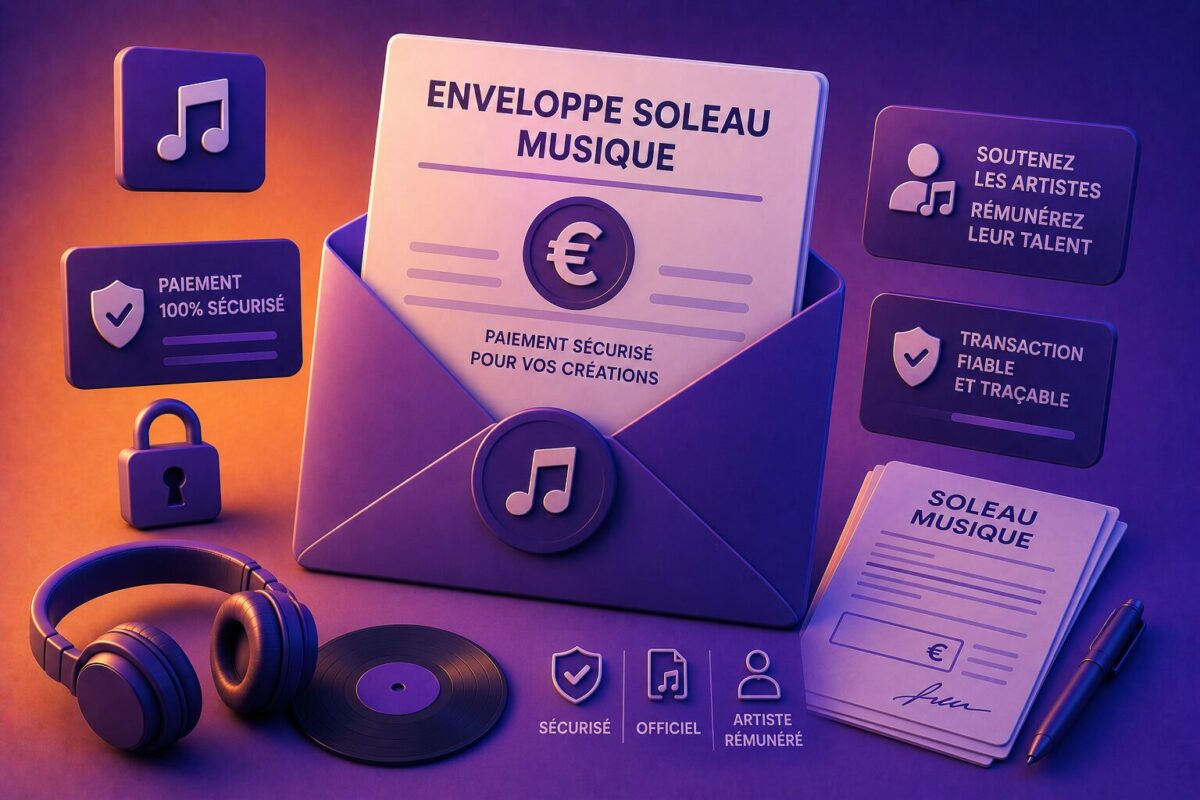
Soleau envelope
music – Complete Guide 2026
How it works, how much it costs, what the real limits are for a musician — and why more and more artists are combining it with a modern digital proof of prior art.
Honest comparison · Official INPI sources · Updated 2026
What is a Soleau envelope ?
The Soleau envelope is an official scheme offered by theINPI (National Institute of Industrial Property) which makes it possible to date the creation of a work with certainty — including a musical work.
The principle
Two identical compartments containing the same documents. The INPI stamps them with the same postmark, returns one to the depositor and keeps the other in its archives for 5 years.
Its legal value
In the event of a dispute before a French court, the archived compartment at the INPI serves as proof of the work's creation date — recognised official state evidence.
Important for musicians: this scheme was historically designed for paper documents — technical drawings, printed scores. Its adaptation to digital musical creations (MP3, WAV, DAW projects) remains limited — we come back to this in detail below.
How does a Soleau envelope
for music
Prepare your identical documents
Two identical sets of your scores, printed lyrics or physical media for your musical work.
Insert them into the two compartments
The paper Soleau envelope includes two physical compartments to be filled with strictly identical content.
Send to the INPI
Purchase the envelope on the INPI official website, then send the two filled compartments for punching and dating.
The INPI punches and archives
Both compartments receive the same dated punch. One compartment is sent back to you, the other remains archived at the INPI.
Keep unopened
The compartment returned to you must never be opened — its integrity is the condition of its evidential value in the event of a dispute.
How much does a Soleau envelope for music ?
| Element | Details |
|---|---|
| Paper envelope price | €15 per item |
| e-Soleau price (digital) | €15 for 10 MB of documents |
| Validity period | 5 years |
| Renewal possible | Once — 10 years maximum in total |
| Processing time | About 15 working days |
| Accepted format (paper) | Punchable documents only — sheet music, printed text |
Beyond 10 years: if you do not renew your envelope before the 5- or 10-year deadline, it loses all evidential value and the INPI destroys the archived compartment. Active monitoring of the deadline is necessary.
e-Soleau: the dematerialised version
To adapt to digital uses, the INPI now offers e-Soleau — an online version of the system, more suitable for creators of digital content.
✅ e-Soleau advantages
- 100% online filing, with no postal mailing
- Accepts digital files (so potentially audio)
- Same legal value as the paper envelope
- Same price: €15 for 10 MB
⚠️ e-Soleau limitations
- 10 MB limit — insufficient for a high-quality WAV file
- Not suitable for full DAW projects or multiple stems
- Processing time still around 15 days
- Interface less geared towards frequent musical use
For reference: a 3-minute WAV file in CD quality usually weighs between 25 and 35 MB — well beyond e-Soleau's 10 MB limit. Most musicians will have to settle for a compressed MP3 export to stay within this limit.
The real limitations of the Soleau envelope
for a active musician
The Soleau envelope is an excellent system — but it was not designed for the creative pace of a modern artist, beatmaker or songwriter.
The 15-day delay
If you need to send a demo to a label tomorrow, the Soleau envelope cannot protect you in time. The processing time is incompatible with the urgency of music distribution.
The limited audio format
Originally designed for perforable paper documents, the classic Soleau envelope is not suitable for audio files. Even e-Soleau is capped at 10 MB — far too little for a high-quality WAV file.
Not suitable for multiple versions
An active artist submits several versions per project (demo, V1, V2, master). Creating a Soleau envelope for €15 for each version quickly becomes expensive and administratively cumbersome.
The deadline to keep an eye on
Unlike permanent proof, the Soleau envelope expires after 5 to 10 years. You must actively manage renewal, or risk losing its evidential value.
Primarily national scope
The Soleau envelope is recognised by French courts. For an artist working internationally, its scope outside France is more uncertain.
No centralised library
Each Soleau envelope is an isolated filing — no dashboard to manage your entire catalogue of protected works in one place.
Soleau envelope vs TuneLockr
Both systems have their place — here is a factual comparison to help you choose according to your situation.
| Criterion | Soleau envelope | TuneLockr |
|---|---|---|
| Timeframe | ~15 days | 2 minutes |
| Cost | €15 per filing | First one free, from €4.90 |
| Validity | 5 years, renewable once (10 years max) | Lifetime |
| Accepted formats | Paper / e-Soleau limited to 10 MB | MP3, WAV, FLAC, ZIP, PDF — with no strict limit |
| Recognition | Official — INPI, French State | eIDAS + Tezos blockchain, 170+ countries |
| International scope | Mainly France | 170+ countries |
| Centralised library | No | Yes — artist dashboard |
| Suitable for frequent filings | Not very practical | Designed for that |
Honest verdict: the Soleau envelope still has a real advantage — it is a state system, which can be reassuring for works of very high commercial value. But for the pace of creation of a modern independent artist — frequent demos, collaborations, multiple versions — TuneLockr is structurally better suited.
Should you combine the two?
For works of very high value — a major single, a full album — combining the two mechanisms offers enhanced protection.
Immediate TuneLockr deposit
From creation onwards — demo, first version — deposit on TuneLockr in 2 minutes. It is your first line of defence, fast and free.
Intermediate versions on TuneLockr
Continue to protect each strategic version throughout the project — V1, V2, master — without any cost or time constraints.
Soleau envelope for the final version (optional)
For a major work intended for significant commercial exploitation, add a Soleau envelope for the final version — an additional layer of official proof.
SACEM declaration after release
Once the work is commercially exploited, declare it to the SACEM to collect your royalties. See: SACEM vs TuneLockr.
The practical rule: TuneLockr for 100% of your everyday deposits. Soleau envelope as an occasional extra only for works of very high value where you want additional official state proof.
🔐 Protect your music in 2 minutes — 1st deposit free
No 15-day delay, no 10 MB limit. Tezos blockchain, immediate PDF certificate, valid for life in 170+ countries.
Protect my music for free →The same deposit, two speeds
Soleau envelope
TuneLockr
Frequently asked questions about
theSoleau envelope for music
TheSoleau envelope is an official INPI device that makes it possible to date the creation of a work, including a musical work, with certainty. It includes two identical compartments — INPI stamps them, returns one and keeps the other for 5 years. In the event of a dispute, the archived compartment serves as proof of the creation date.
The paper envelope costs 15€ for 5 years of validity, renewable once (10 years max). The digital version e-Soleau It also costs €15 for 10 MB of documents. Beyond the renewal, the envelope loses its evidential value.
The classic paper envelope is designed for perforable documents — especially printed sheet music, not audio. The electronic version e-Soleau accepts digital files including audio, but limited to 10 MB — often insufficient for a high-quality WAV file.
Processing time, whether paper or e-Soleau, is generally around 15 working days before full validation by the INPI. This is significantly longer than modern blockchain solutions such as TuneLockr, which issues a certificate in 2 minutes.
Yes — it is recognised by French courts as proof of a certain date of creation, issued by an official state body. Its limitation remains its mainly national scope and its longer processing time compared with digital alternatives.
It is valid for 5 years, renewable once for a maximum of 10 years. Without renewal before expiry, it loses its evidential value and the INPI destroys the archived compartment. The deadline must be actively monitored.
The two are complementary. The Soleau envelope is an official state proof, ideal as a complement for works of very high value. TuneLockr is faster (2 min vs 15 days), accepts all audio formats without a strict limit, is valid for life, and starts with a free first deposit. For regular use, TuneLockr is better suited.
🔐 A lifetime proof,
en 2 minutes.
No delay. No format limit. No expiry to watch for. Tezos blockchain, valid in 170+ countries.
2 minutes · No card required · Valid for life · 170+ countries
Further resources
Learn more about protecting your musical works.
How to protect its music
Complete guide 2026.
Read →Protect your creations
Full workflow.
Read →Protect lyrics
Dedicated guide 2026.
Read →Protect your texts
Authors' guide.
Read →Protect an audio file
3 legal methods.
Read →SACEM vs TuneLockr
Distinct roles.
Read →Musicstart vs TuneLockr
Honest comparison.
Read →Protect a musical work
Complete guide.
Read →Music copyright
Complete guide 2026.
Read →Protect my music
Beathoven Guide 2026.
Read →Official sources: INPI · e-Soleau — official INPI website · SACEM · Intellectual Property Code